If your deals involve engineering, procurement, quality, and operations, ABM isn't a "marketing tactic." It's your Sales + Marketing Operating System for turning best-fit accounts into revenue.
We design and run ABM programs that create engaged accounts, multi-threaded buying committee conversations, and pipeline you can actually forecast.
Most industrial teams already do a version of this… informally. ABM makes it repeatable, measurable, and scalable.
Industrial growth rarely stalls because you "didn't post enough." It stalls because execution is not designed for how industrial buyers actually buy.
Broad targeting (country/industry lists)
Wrong-fit meetings, low conversion
ICP + disqualification + tiering
Single-thread outreach (1–2 contacts)
Deals stall in buying committee
Multi-threaded buying committee coverage
Generic capability pitching
"Send details" → silence
Role-based proof + relevance
No intent prioritization
Chasing noise
Intent thresholds + handoff rules
Sales & marketing operate separately
Mixed messaging, weak follow-up
One coordinated operating system
Weak progression visibility
Forecasting guesswork
Stage-wise dashboards + leading indicators
Fit Check
Best Fit If You Sell
Technically complex products/services with high perceived risk
Deals where engineering + procurement + quality all influence outcomes
Accounts that can be tiered into 1:1 / 1:Few / 1:Many
Where repeat orders, spares/service, expansions, or multi-site rollouts matter
Not a Fit If You Want
Volume lead gen with zero qualification standards
"More leads" without sales discipline or follow-up ownership
A marketing partner that avoids buyer objections and just makes "nice creatives"
This isn't a promise of instant revenue fairy dust. It's an operating system that produces predictable compounding.
Fewer junk conversations, more decision-grade discussions with the right buyers.
More stakeholders engaged per target account — not just one reply.
Fewer stalls, better objection handling, clearer next steps at every stage.
Buyers understand why you faster — through proof, not pitch decks.
Stage-level reporting that informs what to scale, stop, or fix.
First 30–60 Days
Targeting + buying committee model + proof foundation + first warm-up cycles
60–120 Days
Consistent engagement signals + meetings + better qualification discipline
4–6 Months
Stronger pipeline movement + improved conversion velocity + compounding assets
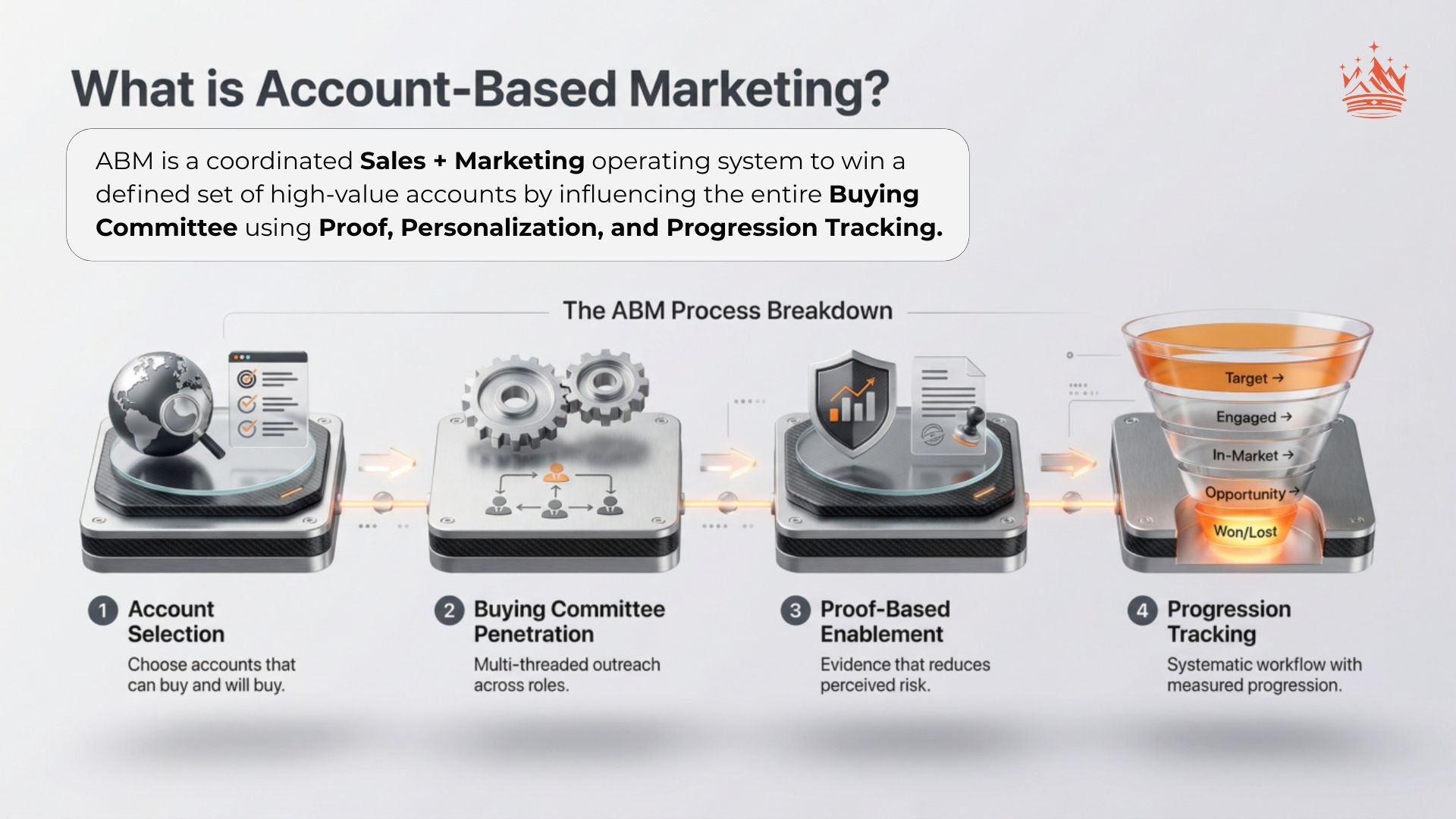
This is the system. Not a "campaign." Each tile is a core process we run inside a modern ABM program for industrial sales.
Define who you win with — and who drains resources.
1:1 / 1:Few / 1:Many — resource allocation that makes sense.
Demand Gen → Intent Threshold → ABM (no silos).
Account + buying committee insights → role-based value mapping.
Credibility before outreach (buyers trust what they've seen).
Convert engagement into meetings/RFQs with proof-led offers.
Committee-wide engagement across channels.
Define when Sales jumps in, with clear ownership.
Blended attribution + sprint reviews + pipeline movement.
Create + capture demand (engagement → intent)
Convert high-value accounts with Industrial Buying Committees
Reduce perceived risk + accelerate progression
Increase speed, consistency, and operational discipline across the entire GTM motion
01
ICP + disqualification → tiering + qualification gates you can defend in a boardroom.
02
Demand Gen → intent signals → ABM routing, with explicit thresholds and ownership.
03
Personalization that feels like insight, not flattery. Account + buying committee insights → role-based value mapping.
04
Familiarity reduces perceived risk, which increases response and progression.
05
Multi-touch, role-aware sequences with proof-led next steps.
06
Committee coverage targets, sales jump-in rules, monthly sprint reviews.
9.1 — Buying Committee Engagement Model
Industrial deals don't stall because your product is weak. They stall because the committee never got aligned.
What They Care About
Technical fit, uptime, integration, feasibility
What We Give Them
Application proof, technical narratives, "how it works" clarity
What They Care About
Risk, vendor reliability, commercial logic
What We Give Them
Credibility + proof + delivery clarity + total value framing
What They Care About
Compliance, validation, audit readiness
What We Give Them
Compliance packs, documentation, process explainers
What They Care About
Reasons not to change
What We Give Them
Objection handling, switching logic, de-risking plan
Committee Coverage Targets
We aim for multiple engaged stakeholders per account, not "one reply"
We sequence engagement: Champion → Influencer → Decision Maker → Blocker management
We build internal alignment between sales + marketing so follow-ups don't collapse
ABM creates committee momentum — the only kind that closes.
9.2 — Intent & Engagement Thresholds
Most teams fail here: either Sales jumps too early (wasting cycles) or too late (losing timing).
RFQ/spec pages, repeated visits, downloads
Active evaluation behaviorReplies, content hub consumption, returning visitors
Growing awareness → warmingExpansion, new plant/line, compliance change, hiring
Buying window formingQuestions about delivery, documentation, qualification
Movement toward procurementThe Threshold Logic
What signals count — clearly defined criteria
How many signals = "engaged" — threshold scoring
Who owns monitoring — clear accountability
What action is triggered — automated or manual
Sales SLA once threshold is hit
Result: Sales follows up at the right time, with the right assets, to the right roles.
9.3 — Reporting & Revenue View
ABM reporting is not "look, impressions." It's: what moved, what stalled, and why.
The output every month: "Scale / Stop / Fix" decisions — not just a pretty dashboard.
ABM is the system. Channels are just how we execute it.
Email outreach + follow-ups
LinkedIn engagement / social selling multithreading
Website + proof infrastructure — content hubs, case snapshots, compliance assets
Micro-events and ecosystem plays
Direct mail for high-stakes Tier 1 accounts optional
Paid distribution/retargeting optional
Your buyer journey reality
Your ICP accessibility
Your proof readiness
Your internal sales bandwidth
DFY Model
You don't need to build a growth department to run ABM.
Provide technical/commercial inputs (offers, constraints, feasibility)
Approve messaging/content in reasonable time
Give sales feedback on lead quality + deal progression
Design the ABM operating system
Build the assets + play library
Run monthly ABM sprints
Optimize using reporting + feedback loops
Weekly: Working sync — blockers, approvals, next actions
Monthly: Performance review, progression, next sprint plan
Portal: Single source of truth (assets don't die in inboxes)
Straight Answers
(without building an internal ABM department)